
Are there demands for bountiful Martian electricity?
Yes, from at least two directions.
One is from SpaceX’s settlement plan; another became public to little fanfare in a recent report by the US National Academies (of Science, Engineering, and Medicine). That report was commissioned by NASA to advise them (NASA) on what Martian science activities they should prioritize in the next few decades.
The top activity recommendation was simultaneously unsurprising and surprising; that is, to look for signs of life indigenous to Mars (completely unsurprising, and as it should be) by drilling several kilometers into the planet’s crust to a depth where water is warm enough to be liquid. This drilling activity is far more energetically ambitious than any other previously considered by NASA. This drilling activity will require electricity supply capacities in excess of 1 MW, and, if carried out optimally, will use tens of megawatts of electricity. Beyond this drilling activity, there are many other possible sources of on-Mars electricity demand.
Power Step Change
In June 2026, NASA’s in-development Mars and moon power systems are only aiming for ~0.1 MW of electricity generation. This leads to small goals that are far less ambitious than the National Academies’ recommended goals. For example, NASA’s top contractor for liberating water from subsurface glaciers, HoneyBee Robotics, is developing automated Rodriquez Well extractors with melting power levels below 3 kW (0.003 MW). A step change in Mars power is needed.
In May 2026, Two Plant Steel responded to a NASA SBIR solicitation with an on-Mars steelmaking proposal capable of delivering tens of megawatts (and more) of electricity for ambitious projects. Using superb local iron ore, our proposal would make steel sheets and rods, then convert these intermediates into steel supports and solar concentrators for solar panel arrays. Simple, easy-to-manufacture versions of the supports and concentrators can achieve an 8X increase in electricity production; so, for example, a set of PV panels rated at 20 kW can be augmented to produce 160 kW of electricity.
Such beginner systems can be stepwise upgraded to achieve much higher electrical generation levels. Although not widely known, the degree of already achieved upgrade from the easy-to-make 8X improvement is so high that interested parties from government, public interest groups, academia, the space industry, and venture capital should stop and study the situation. The practical demonstrations were done in recent years in Australia. These demonstrations achieved a 1000X increase in solar array electricity generation in Southern Australia. In Martian environments, upgrades similar to the Australian ones would easily surpass a 2000X increase in electricity generation (the main reason for this larger multiple is that sunlight striking Mars is less intense than sunlight reaching Australia); with this, a set of PV panels rated for 20 kW of electricity generation from unconcentrated sunlight could generate up to 40,000+ kW (40+MW) in electricity.
Steel-centric wellspring
Two Planet Steel’s Founder, Rolf Miles Olsen, was the first to point out two important points about using steel-making on Mars to make steel concentrators for Martian electricity generation:
- It produces exponential growth in both electricity generation and steelmaking;
- it produces exponential growth in many other very useful activities (more here) linked to electricity generation and steel-making.
This long list of exponential growths can (and should) vastly decrease the cost of establishing a science station on Mars with such capabilities that it will surpass those of McMurdo Station on Antarctica.
Local iron ore collection, steelmaking, steel manufacturing, and electricity generation using steel concentrators are together a potential wellspring for enabling human activities on Mars.
Stages of the wellspring
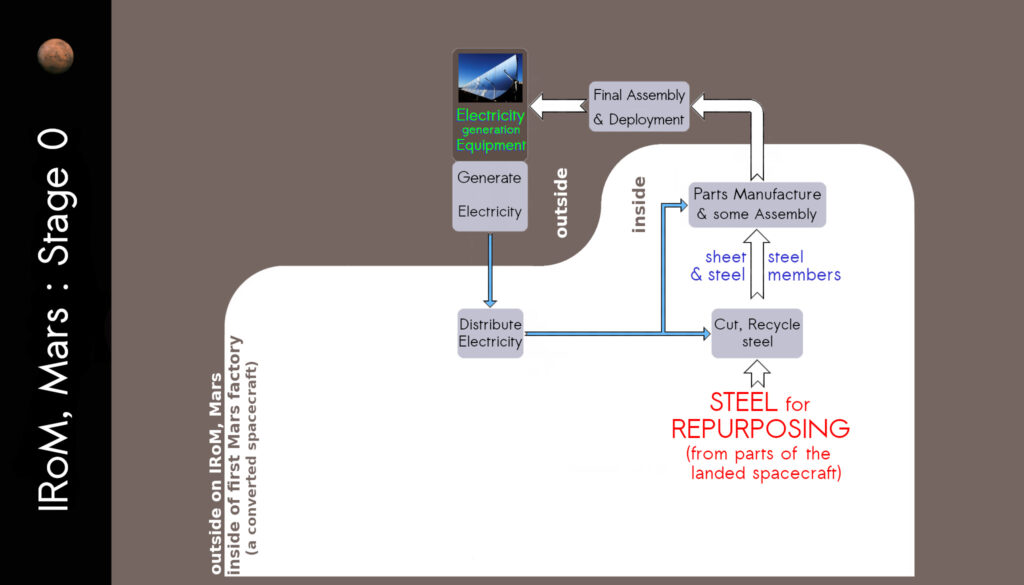
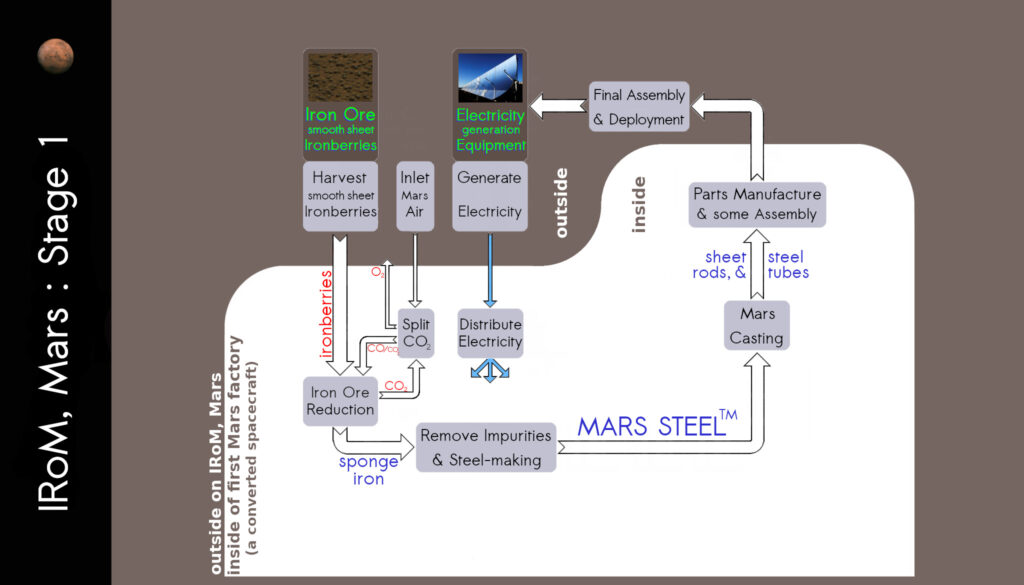
This webpage concludes with a couple of flow diagrams that cover two of the four early stages of a steel-centric route to building a science station on Mars:
Stage 0
Stage 0 is the shortest; it should take less than three months to complete. To begin this stage, the first large rocket to land on Mars has just landed. In this stage, this rocket is rapidly transformed into a Mars manufactory in ways that dismantle and remove (a) its main propellant tanks, and (b) at least half of the former rocket’s vertical structural members. While this occurs, the internal tank and long-member pieces are remanufactured into the first of many solar array supports and sunlight concentrators. This stage rapidly increases solar electricity generation from a very low initial level. The dismantling also frees up a workshop volume near the former rocket’s base, which was occupied by propellant tanks.
Stage 1
Stage 1 starts immediately after the steel repurposing of Stage 0 stops. It also focuses almost all it energies and activities on making even more steel solar concentrator equipment, but now the steel is not repurposed but is made locally by (a) collecting ironberry iron ore from the smooth sheet bedforms of IRoM, (b) direct-reduction of the ore using a reducing gas made by a CO2-splitter (perhaps a water splitter), that is powered by the current supply of electricity, (c) performing adequate impurity removal from the sponge iron output from the direct-reduction furnace, (d), performing, clever Two Planet Steel Mars casting to produce sheet steel and rods, (e) sending the sheet steel and rods to a robotically operated CNC machine shop to make the parts and subsystems of solar concentrators and PV panel supports, and, finally, (f) using roving robotic assemblers to carry out final assembly and deployment of the concentrators and supports on the surface of IRoM, Mars, and in the light of day to increase the overall generation of electricity. Stage 1 will be carried out in about two years, and it will end soon after a second rocket lands close to the established first factory.